







Angélique Auger-Gosselin
Call and Intervention Coordinator at Brio PAE
Diversity, Equity and Inclusion (DEI) in the Workplace: How to Get Started?
In an era of economic, cultural, and lifestyle globalization, cultural pluralism is on the rise and migration patterns are increasing. Faced with this reality, many companies feel at a loss regarding which best practices for DEI (diversity, equity and inclusion) to adopt. It’s perfectly normal not to know where to start: cultural norms vary from one group to another, and the fear of making a misstep can hold back even the best-intentioned initiatives.
More specifically, this article proposes concrete ways to improve a company’s DEI practices at one of the pivotal stages in building an inclusive organization: recruitment and selection. Indeed, resumes with foreign-sounding names are at a significant disadvantage. This obviously applies to newcomers and immigrants in general, but also to young candidates born and/or educated in Quebec (Lavallée, 2020). It is therefore crucial to approach talent recruitment from an inclusive perspective.
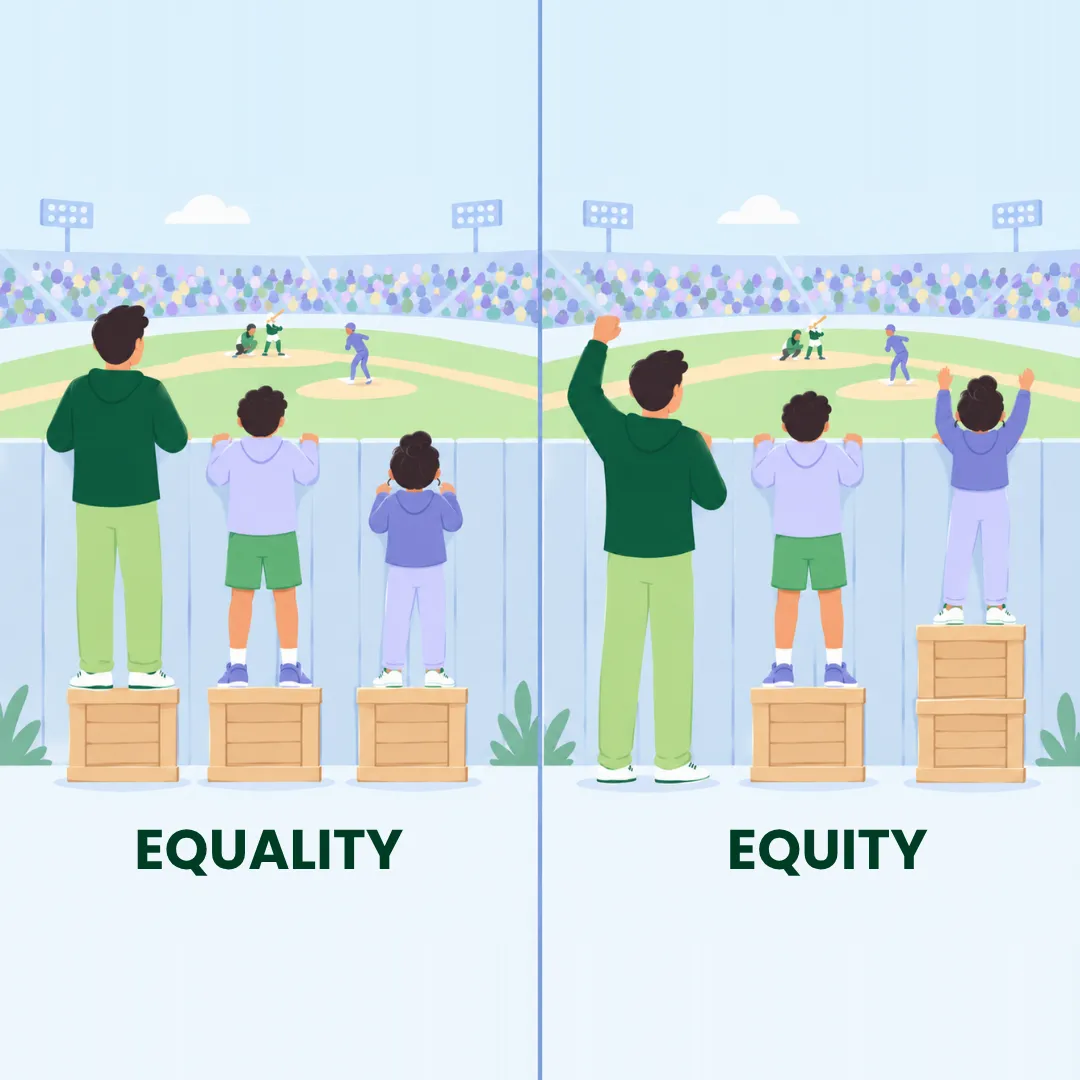
What is DEI?
- Diversity: The recognition and celebration of individuals’ multiple identities and characteristics, including gender, background, sexual orientation, disability, and professional experiences (Lavallée, 2020).
- Equity: Adapting practices and policies to eliminate barriers, address disadvantages, and enable the fair advancement of underrepresented groups (Lavallée, 2020).
- Inclusion: Creating a respectful and equitable environment where everyone is valued, supported, and able to contribute fully to the organization’s mission (Lavallée, 2020).
The Potential Benefits of DEI in an Organizational Setting
Let’s first discuss the benefits that adopting DEI policies can bring to a company. According to a 2019 study conducted in 14 countries, 96% of companies with more than 1,000 employees had implemented a diversity and inclusion program. These inclusive companies were 33% more likely to improve their profitability (Krentz, 2019).
Why are these companies likely to improve their profitability (Krentz, 2019)?
1. Access to the best talents
- What Sets Competitors Apart: Two-thirds of job seekers consider workforce diversity to be a key factor in deciding whether to apply
- Attracting and Retaining Talent: Expanding the talent pool fosters growth and greater prosperity, particularly in the areas of recruitment and workforce expansion
2. A Driver of Innovation
- High-Performing Teams: A strong correlation between diversity on corporate leadership teams and overall innovation: 49% of a team’s problem-solving ability stems from a sense of inclusion in the workplace
- Collaboration Driver: The impact of new employees’ social identity on wow long-time employees interact with other members
3. Your organization becomes a reflection of society
- Better Customer Service: By 2032, one-quarter of the Canadian population is expected to be foreign-born, allowing us to better meet the needs of members of society and a customer base that will become increasingly diverse
- A Necessity for Developing Better Technologies: A growing number of organizations in the sector are promoting inclusive initiatives related to their activities in order to anticipate future challenges and avoid blind spots
- Access to new markets: Promotes the expansion of collaborations and partnerships through a win-win approach
How to Get Started: Best Practices for DEI in Recruitment and Selection
A good first step is recruitment, from writing the job description to attracting, selecting and hiring the right people.
Job Description
The use of adjectives in job descriptions such as “competitive ” and “determined” tends to be perceived as more masculine by candidates, while “collaborative” and “cooperative” tend to attract more women (Trix & Carolyn, 2003).
“Women only apply for a job when they meet 100% of the criteria listed in the job description.” (Lavallée, 2020)
It is therefore essential to draft job descriptions that reflect the skills required for the desired position.
Here are a few examples of best practices:
- Specify that people with disabilities may request accommodations during the process
- Identify the level of French and English proficiency the job truly requires.
- Avoid job postings written exclusively in masculine or feminine terms; use inclusive language
- List the required degrees and where they must have been obtained, along with acceptable equivalents.
Attraction: How Can We Attract and Engage a Diverse Audience?
Examples of best practices:
- Share the organization’s values of inclusivity
- Display photos and highlight models of diversity
- Participate in events to promote the organization’s DEI initiatives and communicate that you provide equal opportunities to everyone
- Revise your referral program to ensure it promotes the hiring of diverse candidates
Staff Selection
Examples of Best Practices
- Form a selection committee that reflects diversity
- Provide training for recruiters on bias and prejudice
- Be transparent throughout the process
- Select resumes without bias: without names or countries, based solely on education and experience
- Do not take accents into account and allow for flexibility in the screening methods: video, phone, or in-person (or offer a choice)
- Use a standardized grid
- Assess the language proficiency required for the job
- Assess skills, training, and prior learning, and take into account non-academic skills
- Select Psychometric Tests Free of Cultural Bias
Talent Acquisition
Examples of best practices:
Development of a welcome and onboarding guide that includes:
- History of the Organization
- Expected Behaviors
- Organizational Culture
- Customer Service
- Code of Conduct
- Development Process
- Etc.
Training and Integration
- Provide tailored training, mentoring, and practical tools to help new employees adjust
Accessibility and Diversity
- Adapt workplaces and processes to meet the needs of people with disabilities
Support and Guidance
- Train managers and pair new employees with experienced colleagues to ensure a successful onboarding process
DEI in the Workplace: An Ongoing Process
DEI is no longer just a trend in human resources management: it is a strategic lever whose benefits are now well documented. As we have seen, companies that prioritize diversity and inclusion gain access to a broader talent pool, foster innovation within their teams, and position themselves advantageously in a society that is itself becoming increasingly diverse. However, these benefits do not materialize on their own. They stem from concrete actions taken from the very beginning of the employment cycle. It is important to remember that DEI is not a one-time project, but an ongoing process that requires regularly re-examining established practices.
Adopting sound DEI practices in recruitment means choosing an organization that is not only more equitable but also more effective and better equipped to thrive in a constantly changing world of work.

“It is not our diversity which divides us; it is not our ethnicity, or religion or culture that divides us.”
– Nelson Mandela
Sources
Denis, Pascale L., Asselin, Sophie, Simard, Myriam, Paré, Frédéric, Benoit-Chabot, Gabrielle, « L’interdiction de la discrimination en emploi et les pratiques de recrutement et de sélection des PME assujetties au droit du travail québécois », La Revue du Barreau, (2015) 74 R. du B. 187, Montréal, Barreau du Québec.
Dixon-Fyle, S., V. Hunt, K. Dolan, and S. Prince (2020). *Diversity Wins: How Inclusion Matters*, McKinsey & Company, p. 17
Eid, Paul, (2012). Mesurer la discrimination à l’embauche subie par les minorités racisées : résultats d’un « testing » mené dans le Grand Montréal, Commission des droits de la personne et des droits de la jeunesse, Québec, [en ligne]. Repéré à : https://www.cdpdj.qc.ca/storage/app/media/publications/etude_testing_discrimination_emploi.pdf.
Frank Dobbin and Alexandra Kalev. “Why Diversity Programs Fail,” Harvard Business Review, 2016.
Groupe Conseil Continuum (2005). Guide pratique de la gestion de la diversité interculturelle en emploi. Emploi Québec
Hunt, V., Prince, S., Dixon-Fyle, S., & Yee, L. (2018). Delivering through diversity
Hydro-Québec. (n.d.). Diversité et inclusion. Hydro-Québec. https://emploi.hydroquebec.com/content/Diversite-et-inclusion/
Interactive Ontario. (2017). Diversity and inclusion toolkit (Version française). Interactive Ontario. https://interactiveontario.com/wp-content/uploads/2019/11/io_diversity_inclusion_toolkit_2017_FRENCH_optimized_web.pdf
Krentz, M. (2019). Survey: What diversity and inclusion policies do employees actually want? Harvard Business Review, 5
Langelier, E. et J. Brodeur (2020). Introduction à l’équité, la diversité et l’inclusion en enseignement supérieur et en recherche, Chaire pour les femmes en sciences et en génie, p. 34
Lavallée, B. (2020). Guide de saines pratiques RH : La valorisation de la diversité en milieu de travail. CRHA. https://reseaucctt.ca/medias/documents/Guide-de-saines-pratiques-RH_Diversite-et-inclusion.pdf
OIQ. (2022). Femmes en génie : Guide de l’employeur pour un milieu de travail plus diversifié, inclusif et équitable. https://www.oiq.qc.ca/wp-content/uploads/documents/Communications/femmes_en_genie_guide_employeur.pdf
Phillips, K. W., K. A. Liljenquist, and M. A. Neale (2009). “Is the Pain Worth the Gain? The Advantages and Liabilities of Agreeing With Socially Distinct Newcomers,” *Personality and Social Psychology Bulletin*, 35(3), p. 336-350.
Régner, I., C. Thinus-Blanc, A. Netter, T. Schmader et P. Huguet (2019). Committees with implicit biases promote fewer women when they do not believe gender bias exists, Nature Human Behaviour, 3, 1171–1179
Trix, Frances and Psenka (2003), “Exploring the Colour of Glass: Letters of Recommendation for Female and Male Medical Faculty,” Discourse & Society,14(2); Women in Science & Engineering Leadership Institute (2012), Reviewing Applicants: Research on Bias and Assumptions.