






Written by Julia Kack, organizational health consultant | Doctoral candidate in work psychology
How to turn psychosocial risk prevention into a driver of sustainable performance?
Psychosocial risks (PSR) in the workplace are an increasingly pressing issue.
They have real effects on employees’ mental and physical health, as well as on organizational performance.
According to the INSPQ, they contribute to absenteeism, disengagement, and a deteriorating work climate.
For organizations, preventing psychosocial risks is no longer simply desirable; it has become a legal and strategic responsibility.

Why integrate PSR into your organizational strategy?
In Quebec, the Act respecting occupational health and safety (AOHS) requires employers to protect their employees’ mental health.
Beyond this obligation, PSR prevention becomes a powerful lever for :
- Reducing employee turnover
- Reducing absenteeism
- Mobilizing teams
- Fostering a climate of trust
A healthy workplace also means a more efficient organization!

What are psychosocial risks?
PSR are factors related to work organization, management practices or interpersonal relationships that can harm mental and physical health.
Common examples of PSR :
- Excessive workload
- Lack of autonomy
- No recognition
- Conflicts or tensions within the team
- Harassment or incivilities
- Feeling of injustice or unfairness
Every work environment has its own realities. Identifying sources of stress is a crucial first step.
Find out more about our psychosocial risk analysis approach.

What are the scientific foundations of PSR?
RPS are based on models that have been widely studied in occupational health:
The requirements-control model (Karasek)
An environment that combines high demands and little autonomy can generate chronic stress.
The Effort-Reward Model (Siegrist)
When efforts are not compensated by fair rewards (salary, recognition, promotion), stress increases.
Organizational justice
A sense of justice (in decisions, processes and relationships) strongly influences commitment and well-being.
Leadership
Clear, consistent, mobilizing leadership acts as a protection factor. Conversely, weak or inconsistent leadership can be detrimental to organizational health.
How to go from diagnosis to action?
Conducting a psychosocial risk assessment is good. Turning it into a driver for change is even better.
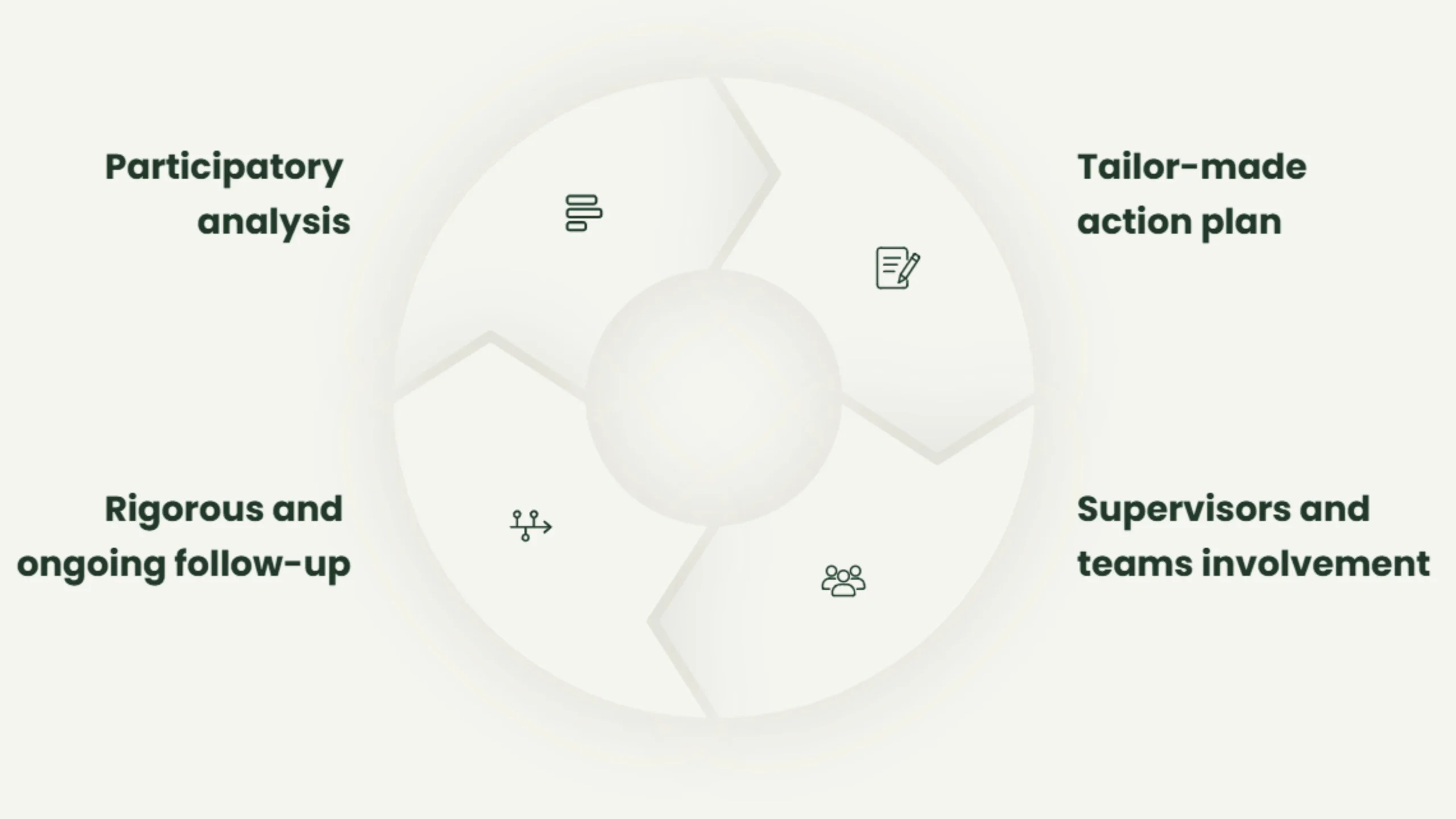
An effective approach is based on :
- A participatory analysis of the work climate
- Involvement of supervisors and teams
- A tailor-made action plan, rooted in the organization’s reality
- Rigorous and ongoing follow-up
When employees feel listened to, supported and recognized, psychological health becomes a pillar of sustainable performance.
In summary
- PSR have tangible impacts on health and performance
- Their prevention is a legal obligation in Quebec
- Reliable models help us better understand the causes
- A well-conducted diagnosis can transform your organization
FAQ - Psychosocial risks
in the workplace
What are the first signs of PSR in a team?
A rise in absenteeism, recurring conflicts, disengagement or a drop in productivity can all be signs.
Which sectors are most affected by PSR?
All environments are affected, but high-pressure sectors (healthcare, education, services, etc.) are often more at risk.
Who should initiate the prevention process?
Management plays a central role, but the involvement of supervisors and employees is essential for a sustainable approach.
Want to take action?
Do you want to better understand the risks present in your organization and implement concrete solutions?
Our specialized organizational health team is here to support you.
References
INSPQ. (2024). Psychosocial risks at work. https://www.inspq.qc.ca/risques-psychosociaux-du-travail-et-promotion-de-la-sante-des-travailleurs/risques-psychosociaux-du-travail
LégisQuébec (2025, April1st ). Act respecting occupational health and safety. https://www.legisquebec.gouv.qc.ca/fr/document/lc/S-2.1
Ndjaboué, R., Vézina, M. and Brisson, C. (2012). Effects of psychosocial factors at work on mental health. A literature review of prospective studies on three emerging models. Travail et emploi, 129(1), 23-34.
https://doi.org/10.4000/travailemploi.5515.
Weissbrodt, R., Arial, M., Graf, M., Ben Jemia, T., Villaret d’Anna, C., and Giauque, D. (2018).Preventing psychosocial risks: a study of employers’ perceptions and practices. Relations industrielles / Industrial Relations, 73(1). https://doi.org/10.7202/1044431arhttps://doi.org/10.7202/1044431ar